LoveSquishy Journal
Coconut Oil Squishy Guide: No-Rebound Feel, Real vs Knock-Off, How to Pick
A coconut oil squishy is a glossy, translucent squeeze ball that holds a dent. Here's what the name means, how no-rebound differs from slow-rise, and what to check before you buy.

On this page
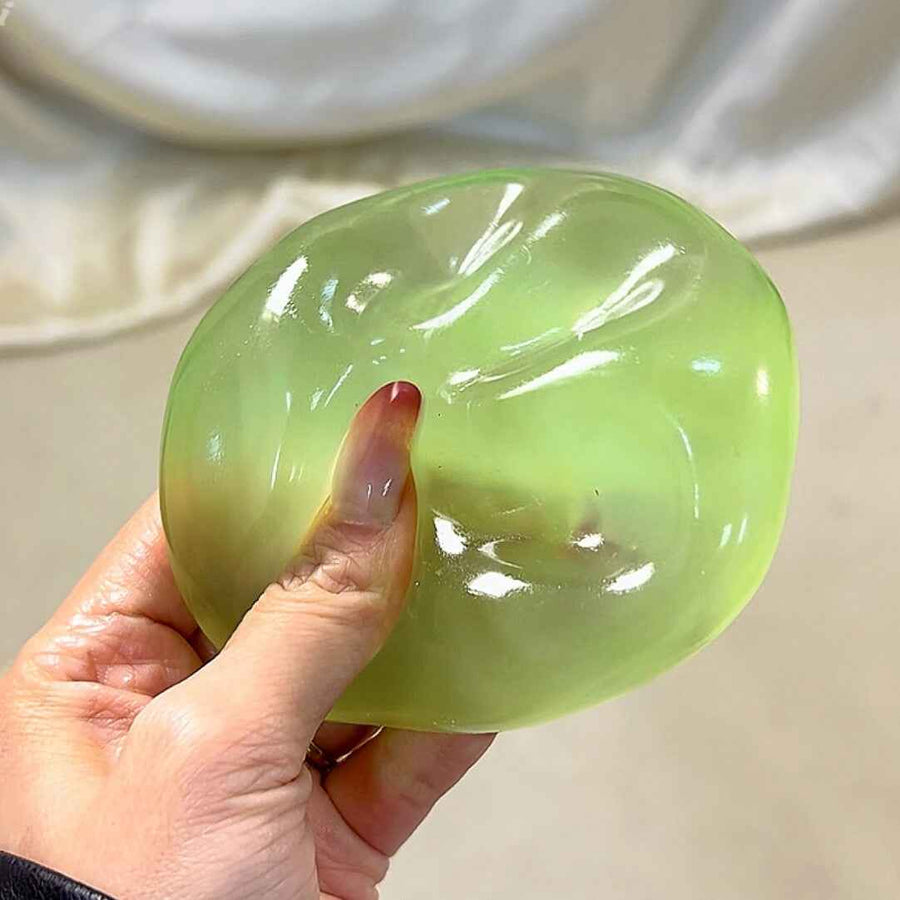
A coconut oil squishy is a glossy, translucent, gooey squeeze ball that holds a dent when you press it instead of springing back. "Coconut oil" is the name of the style, not an ingredient. If you already know you want one, the Chiboki coconut oil squishy comes in six colorways. If you're still deciding, this guide explains the feel, what's actually inside the name, and what to check so you don't end up with one that breaks in a week.
What is a coconut oil squishy?
It's a squishy defined by look and feel. The surface is glossy, the body is translucent, and when you squeeze it the shape gives way and stays pressed in for a while. On our product page we describe the Chiboki version as "a glossy, translucent, gooey ball that holds a dent when you squeeze it," and we say plainly that it is a toy, not a food or skincare product.
That last point matters because the name confuses people. Searches like "real coconut oil squishy" show up regularly in our Search Console data. The honest answer is that the label describes a style, the same way "jelly" or "mochi" does on other squishies.
What "no-rebound" actually feels like
No-rebound means the squishy keeps part of the shape you squeeze into it instead of bouncing back right away. You press a thumb in, let go, and the dent is still there. That's the whole appeal: it feels moldable rather than springy.
No-rebound vs slow-rise vs bouncy
Store listings mix these terms up, and some sellers call the same coconut oil squishy both "slow rise" and "no rebound." They are different feels:
| Feel | What happens after you squeeze | What to look for in a listing |
|---|---|---|
| No-rebound | Holds part of the squeezed shape instead of springing back right away | "Non-rebound," "moldable," or a photo or video of a dent that stays |
| Slow-rise | Sinks in, then gradually returns to its original shape | "Slow rising," usually on foam squishies |
| Bouncy | Pops back almost immediately | "Fast rebound," "bouncy," or "springy" |
These are performance terms, not materials. Our squishy materials comparison explains why non-rebound and slow-rising describe how a squishy behaves, not what it's made of. For a wider look at texture and size, see how to choose a squishy.
Is there real coconut oil inside?
No ingredient claim comes with the name. On the Chiboki product page, "coconut oil" is explained as "the name of this squishy style — glossy, translucent and non-rebound." We don't list coconut oil as a fill, and we don't describe the fill on that page, so we won't guess at it here.
Treat a listing that promises "real coconut oil filling" as a reason to slow down, not a selling point. A squeeze toy is not food or a cosmetic, and an ingredient claim like that is hard to check. Either way, the rule is the same: don't bite it, cut it open, or swallow it.
Real vs knock-off: what to check before you buy
A common worry among shoppers is copies that break soon after they arrive. You can't test a squishy through a screen, but you can screen the listing. Before you buy, check for:
- Photos of the exact colorway. One stock image for every option tells you little. Look for separate photos per colorway, ideally one showing a dent held after a squeeze.
- A stated rebound type. The listing should say non-rebound and not contradict itself with "slow rise" two lines later.
- An honest note on firmness. Handmade-style squishies vary. Our page says firmness "can vary by option and batch," which is more useful than a promise that every one feels identical.
- Clear lines on breaks and leaks. Look for a seller who answers questions about breaks and leaks and tells you what to do if one arrives that way. On our product page, the instruction is: "Breaks, leaks or incorrect items? Contact us with photos or a video if available."
- Reviews that talk about feel and durability. Star ratings alone don't help much. Read the low ratings too, since they often tell you more about firmness than the five-star ones.
- No ingredient promises. Skip listings that sell the "real oil inside" angle.
Our page also lists what counts as normal handmade variation: "Small fibers, tiny dark specks, mold marks, slight edge curling or creases in the outer bag may occur." It adds: "Breaks and leaks are not treated as normal handmade variations." Knowing that line in advance helps you tell a cosmetic quirk from a real problem.
What buyers say about the feel
The Chiboki coconut oil squishy showed a 4.22 average from 9 reviews on its product page when we checked on November 5, 2026. Two verified reviews sum up the range:
"Very satisfying to squish."
— Natalie C., verified buyer
"The squishy is firmer than I anticipated, making it a bit hard to squeeze. It's well-made, but I was looking for something softer."
— David Martinez, verified buyer
If you want something very soft, take the firmness comments seriously and look closely at the photos of the colorway you're considering.
How to pick yours: the six Chiboki colorways
Every colorway is an option on the same product page. Here is how each one is listed:
| Colorway | Look (as listed) |
|---|---|
| Pink Coconut Oil Soft Squishy | Translucent pink |
| Blue Coconut Oil Soft Squishy | Translucent blue |
| Taro Purple Jade & Coconut Oil Squishy | Translucent taro purple |
| Pig fat paste | Translucent pale yellow |
| Jade-colored Green Grapes | Translucent green |
| Sea Blue Jade Beads | Translucent blue-green |
Price on November 5, 2026: from $25.90 (Taro Purple Jade $26.90). Prices can change, so confirm the live price on the product page before you order. Since firmness can vary by option, pick by the photos of that specific colorway rather than by the first image you see.
The coconut oil ball is one of several Chiboki designs. For other Chiboki styles, there are Chiboki bottle squishies, and you can see the full range in the Chiboki squishy collection.
Gifting tips
- Pick a colorway with them in mind. If you're unsure, the pink and blue options are the simplest looks; the jade, grape and pale yellow options are more distinctive.
- Set expectations on small details. Handmade colors and details can vary, so the one that arrives may not match a photo exactly.
- Check timing on the page. When we checked, the product page listed worldwide shipping, handmade to order, and ships within 48 hours. Confirm those notes are still shown before you count on a date.
- Want a different squeeze? Browse our squeeze ball collection for other shapes and feels.
Care and when to stop using it
The product page gives three care basics: keep it away from sharp objects, excessive heat and rough surfaces, and stop using it if the outer layer is damaged. Don't bite it, cut it open or swallow it. Adult supervision is recommended for kids.
Our squishy care guide groups coconut-oil style balls with other filled designs that have a soft outer layer, and covers storage and when to retire a squishy.
Coconut oil squishy FAQ
What is a coconut oil squishy?
A glossy, translucent, gooey squeeze toy that holds a dent when pressed. "Coconut oil" names the style, not an ingredient.
Does a coconut oil squishy have real coconut oil in it?
The name is the style. It's a toy, not food or skincare, and you should be wary of listings that advertise real oil filling.
Is a coconut oil squishy slow-rise?
No. It's non-rebound: it holds part of the squeezed shape instead of springing back right away. Slow-rise squishies gradually return to their original shape.
Where can I buy one?
The Chiboki version is sold on LoveSquishy in six colorways on a single product page.
Shop the Chiboki Coconut Oil Squishy
Ready to pick a colorway? See photos of all six options and the current price on the Chiboki coconut oil squishy page.
Explore different squishies
CHIBOKI Squishy Collection ↗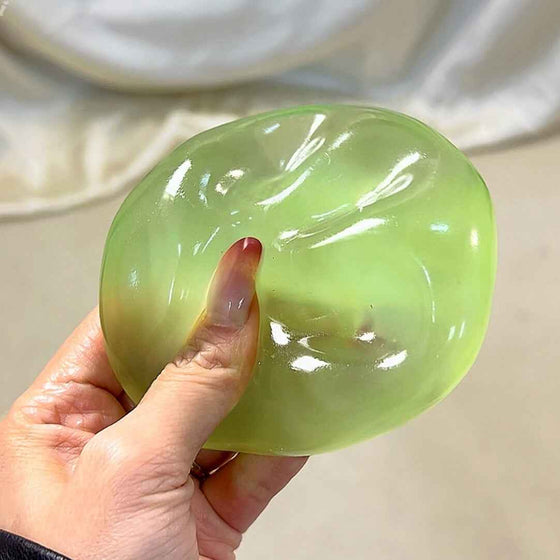
Read more
How to Choose a Squishy: Texture, Rebound & SizeAfter Cutting Open a Squishy, I Realized It Wasn’t So Simple!